
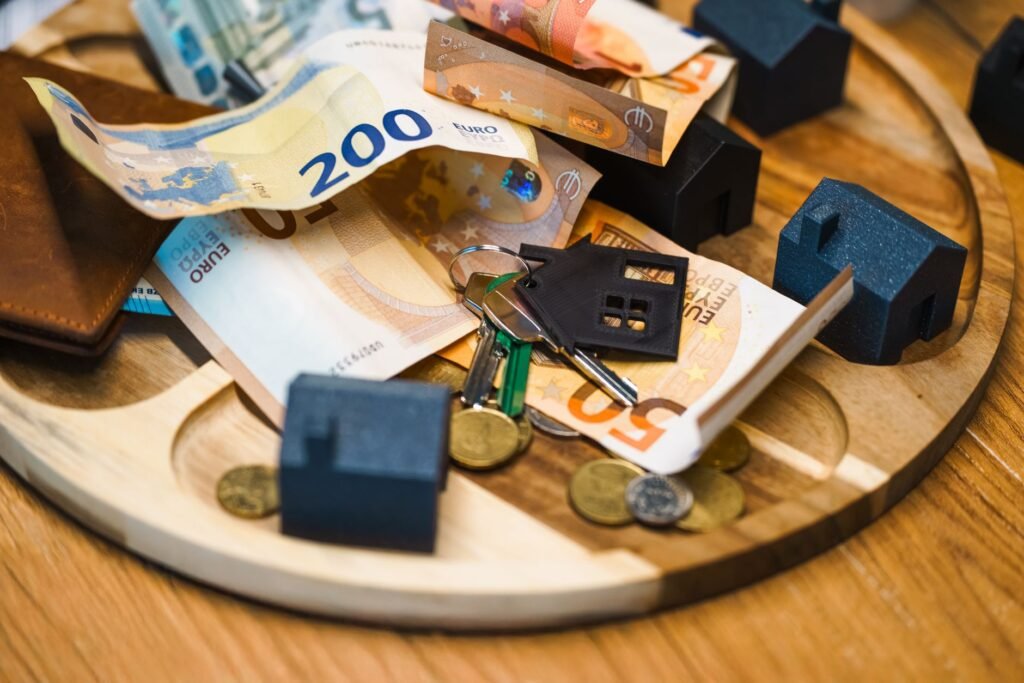
A mortgage for German buyers in Dubai works on the same UAE banking rules as any other foreign buyer’s mortgage, and the same is true for French, Dutch, Italian and other European nationals. The bank does not care much about your passport. It cares about whether you are a UAE resident or not, where your income comes from, and whether your deposit can be traced. What makes the European case different is not a capital control or a banking blacklist. It is a set of practical frictions: moving euros into dirhams, proving where the money came from, the tax position back home, and the fact that a home-country bank will almost never lend against a Dubai flat.
This guide is written from a mortgage-broker perspective. It covers the resident versus non-resident loan-to-value (LTV) split, the cash you need at AED 1 million, AED 2 million and AED 3 million on today’s benchmark rates, how the euro-to-dirham transfer and source-of-funds checks work, what the Germany and France tax picture looks like at a high level, and how the dirham’s dollar peg creates currency risk for a buyer who earns in euros.
Published: 6 October 2026
Can German and French nationals get a mortgage in Dubai?
Yes. German, French and other European nationals can obtain a UAE mortgage, either as UAE residents on standard resident terms or as non-residents on lower-LTV terms. UAE banks set their own eligibility rules and we found no published rule that bars German, French or other EU/EEA nationals. Some banks keep internal country lists for non-resident lending, and those lists are not public, so a lender-by-lender check before you apply is sensible.
Foreigners can buy freehold property in Dubai’s designated freehold areas whatever their nationality, so the real question is never whether you may own, but how a bank will treat your file and how you will fund the deposit.
How many Europeans actually buy in Dubai is harder to say than most marketing pages suggest. The Dubai Land Department (DLD) does not publish transaction data by buyer nationality, so every nationality ranking is an estimate compiled by agencies. One early-2026 breakdown by Harbor Real Estate using DXBinteract data put German buyers at about 4.2% and French buyers at about 3.8%. Other sources disagree: Oliva’s DLD-based table puts each of the two at roughly 2% to 3% of foreign transactions, and Sandwater puts French buyers at 5% to 7% of all transactions. We report the disagreement rather than pick a figure, and we treat all of them as estimates. What every source agrees on is that Germans and French are a small but real slice of the market, well behind the largest groups covered in our guides for Indian, UK and Egyptian buyers.
Resident or non-resident: the split that decides your loan
The single biggest driver of your terms is residency, not nationality. A resident expat can borrow up to 80% of a first home worth up to AED 5 million; a non-resident is typically limited to roughly 50% to 60% on a completed property. The 80% figure is the Central Bank of the UAE (CBUAE) maximum for expatriate residents on a first property up to AED 5 million, falling to 70% above that value (the same figures we use in our down payment rules guide). Second and subsequent properties for residents carry a lower cap, and off-plan purchases are capped at 50% for every buyer category.
Non-residents are different. Several of the broker sources we checked state that the CBUAE publishes no single non-resident LTV matrix and that non-resident products run below the regulatory ceilings under each lender’s own risk policy. Typical reported ranges are 50% to 60% on ready property, with one bank (Mashreq) reported at up to 65% in one source and another source quoting a wider 50% to 75% range by bank. Because the sources do not agree, treat 50% to 60% as a planning range for a first conversation and confirm the actual figure with the lender. Our non-resident mortgage guide covers the mechanics in more depth.
| What changes | Resident (UAE visa and UAE salary) | Non-resident (living in Europe) |
|---|---|---|
| Typical maximum LTV, ready property | Up to 80% (first home up to AED 5M) | About 50% to 60% (bank policy, varies) |
| Minimum deposit | 20% | About 40% to 50% |
| Income assessed | UAE salary, DBR 50% cap | Overseas income, converted to AED by the bank |
| Number of lending banks | Wide | Narrower |
| Off-plan LTV | Capped at 50% (CBUAE) | Capped at 50% (CBUAE) |
If you work in the UAE and hold a residence visa, you are in the left-hand column even if your family lives in Germany or France. If you live and work in Europe and want a Dubai holiday home or an investment unit, you are in the right-hand column. A German or French national who is relocating to Dubai within a year or so should ask a broker whether it is cleaner to wait until residency is in place, because the difference in deposit is large.
What does a mortgage cost on today’s benchmark rates?
On current benchmarks a variable UAE mortgage costs roughly 6% a year, and the euro equivalent is far more expensive than a euro mortgage at home. A worked example is only credible on real current rates, so here are the inputs we checked this session.
- The CBUAE raised its Base Rate by 25 basis points from 3.65% to 3.90% with effect from 17 September 2026, as covered in our September 2026 rate hike guide.
- The 3-month EIBOR (Emirates Interbank Offered Rate) was about 4.30% on the 5 October 2026 update of the FCMB EIBOR page, which republishes the rates set by the Central Bank. The overnight rate on that page was about 3.71% and the 12-month rate about 5.05%. A separate market page showed 4.34% on 29 September, so we use about 4.3%.
- For comparison, the euro benchmark 3-month Euribor was 2.598% on 2 October 2026 according to euribor-rates.info.
- We assume a bank margin of 1.8%, inside the band used in our recent guides. That gives an all-in variable rate of about 6.1% on a 25-year term. Your actual margin, and any fixed-rate offer, will differ.
The gap between a UAE benchmark near 4.3% and a euro benchmark near 2.6% is worth stating plainly. A European buyer comparing a Dubai mortgage with a mortgage at home will see a higher rate in Dubai, and the rate is only part of the comparison, because the dirham is pegged to the US dollar and not to the euro. We come back to this in the currency section below. For how EIBOR feeds into your repayment, see our EIBOR explainer, and for the choice between locking in and floating, see fixed vs variable.
Cash needed at completion
| Scenario | Loan | Monthly payment (6.1%, 25 yrs) | Gross income needed at 50% DBR (no other debt) | Cash needed at completion* |
|---|---|---|---|---|
| AED 1,000,000, non-resident at 60% LTV | AED 600,000 | about AED 3,903 | about AED 7,806 | about AED 447,790 |
| AED 2,000,000, non-resident at 60% LTV | AED 1,200,000 | about AED 7,805 | about AED 15,610 | about AED 895,290 |
| AED 2,000,000, resident at 80% LTV | AED 1,600,000 | about AED 10,407 | about AED 20,814 | about AED 500,290 |
| AED 3,000,000, non-resident at 60% LTV | AED 1,800,000 | about AED 11,708 | about AED 23,415 | about AED 1,342,790 |
*Deposit + DLD transfer fee (4% of the price) + mortgage registration (0.25% of the loan plus AED 290) + a 1% bank arrangement fee. It excludes valuation, agent, trustee, insurance and any NOC costs, which vary. Since February 2025 these fees cannot be funded by the mortgage, so they must be paid in cash. See our real cost of buying property guide for the fee breakdown.
The table shows the gap between the two columns. The same AED 2 million apartment needs about AED 500,000 in cash for a resident and about AED 895,000 for a non-resident at 60% LTV, which is roughly AED 395,000 more. At the pegged rate that difference is a large sum to move, document and defend to a bank. These are illustrations on assumed terms, not an offer.
The monthly payment is the same arithmetic for both groups, but the income test differs. A resident is measured on a UAE salary. A non-resident is measured on overseas income that the bank converts to dirhams and may haircut. Our eligibility guide explains how banks size the loan from your income.
Why a European bank will not lend against Dubai property
In general, a home-country bank will not take a Dubai property as security, so a European buyer’s financing options are a UAE mortgage, cash, or raising money against assets at home. A mortgage is secured on the property, and the lender must be able to register and enforce its charge. UAE banks register their mortgage with the DLD against the title deed, and that is the system they know how to enforce. A German Sparkasse or a French bank would have to enforce through a foreign legal system, which is why such lending is rare. Confirm this with your own bank, but do not plan around a home-country mortgage on a Dubai asset.
What buyers do instead:
- Borrow in the UAE. A UAE bank lends against the Dubai property in dirhams. This is the route this guide covers.
- Fund the deposit from assets at home. That may mean savings, the sale of an asset, or an equity loan against a home property. Whatever the source, the bank will ask you to prove it, which is the next section.
- Pay cash. Many European buyers do, particularly for off-plan units on a developer payment plan, where no mortgage is needed until handover. Our off-plan mortgage guide explains when a bank finance step arrives.
How euros reach Dubai: transfers and source of funds
Euros move to the UAE by international wire transfer, and the bank will want proof of where those euros came from. The Single Euro Payments Area (SEPA) scheme covers euro payments inside Europe, not payments into the UAE, so a transfer to a UAE bank account or to the developer or DLD is an international (SWIFT-type) payment that is converted from euros into dirhams. Conversion costs and the exchange rate vary between banks and transfer providers, so quote them before you commit and compare the all-in cost, not the headline rate.
UAE banks screen source of funds under anti-money-laundering rules, and a European buyer should expect to be asked for documents. Strong evidence looks like this:
- Six months of bank statements from the account the money leaves, showing the balance and the history behind it.
- Proof of the origin of the funds: payslips and tax assessments for earned savings, a sale contract and notary or land-registry confirmation for property sale proceeds, or a probate or inheritance document where relevant.
- A gift letter with the donor’s ID and proof of their funds, if a family member contributes. Ask the bank in advance whether it accepts gifted deposits at all, because policy varies.
- A transfer trail that matches: the account holder, the amount and the date on the statement should match the credit in the UAE.
Keep the transfer in your own name and send it from your own account. A deposit assembled from several unexplained transfers invites a delay or a refusal, and splitting a large sum into small transfers to avoid attention is a red flag, not a workaround. Our documents checklist lists the standard file for each buyer type.
Tax: what to check at home before you buy
The UAE does not charge personal income tax on rental income, but your home country may. This is a tax-adviser question and not a mortgage question, and we are mortgage consultants, not tax advisers, so this section only flags what to take to one.
Germany. A person who is tax-resident in Germany is generally taxed on worldwide income, which includes rental income from a foreign property. A double taxation agreement (DTA) usually gives the primary taxing right on property income to the country where the property sits. The point for German buyers is that, according to SKW Schwarz, there has been no UAE-Germany DTA in force since 31 December 2021. Other sources give a June 2021 expiry date for the second treaty, so the exact date differs by source but the conclusion matches: no treaty has applied since 2022. Without a treaty, the treaty’s relief mechanisms are not available, and the answer depends on German domestic law. Because the UAE levies no personal income tax on the rent, there is typically no UAE tax to credit, so a German resident should expect Germany to tax the rental profit. That is a point to confirm with a German Steuerberater before you rely on a yield figure. Germany also has an “extended limited tax liability” rule that can keep German-sourced income within the German tax net for ten years after a move to a low-tax country such as the UAE. That is relevant for a German who is relocating to Dubai while keeping property or income in Germany.
France. Commercial tax sources list a France-UAE treaty signed in 1989, which follows the usual rule that income from immovable property may be taxed where the property is located. We could not verify the treaty’s current text from a primary source this session, so check the UAE Ministry of Finance treaty list and the French tax authority (impots.gouv.fr) before you rely on it. French tax residents are generally taxed on worldwide property, and the French reporting rules for foreign accounts (Form 3916) apply to accounts held abroad, such as a UAE bank account, though they cover accounts and not real estate itself. Penalties for missing the account declaration are reported at EUR 1,500 per account per year, up to EUR 10,000, and a French tax adviser can confirm the current position.
Everyone else in Europe. The same pattern applies: your country of tax residence decides what you declare, the UAE does not tax the rent, and the DTA position varies by country. Ask your adviser two questions before you buy. Is rental income from a UAE property taxable in my home country, and what must I report about a UAE bank account and the property?
Currency risk: the dirham follows the dollar, not the euro
A European buyer who earns in euros and repays in dirhams carries an exchange-rate risk that a UAE resident earning in dirhams does not. The dirham is pegged to the US dollar at a fixed rate, so the dirham moves against the euro whenever the dollar moves against the euro. If the euro weakens against the dollar, every dirham instalment costs more euros. The arithmetic is simple: a 10% fall in the euro against the dollar raises the euro cost of the same AED payment by about 11%, because you need more euros to buy the same dirhams.
For the example above, a non-resident paying AED 7,805 a month on a AED 2 million property at 60% LTV is exposed to the euro-dirham rate every month. Rent received in dirhams offsets some of this, because it arrives in the same currency as the instalment. This is one reason a euro-income buyer who is keeping the property as a rental unit manages the risk better than one who needs to cover the instalment from euro salary.
Practical ways to manage it include holding a dirham balance to cover several months of instalments, funding the deposit at a moment you choose and not on a deadline, and asking whether a fixed rate for a first period suits your risk tolerance. A variable loan adds a second moving part, because the EIBOR link moves your instalment even if the exchange rate does not. Our rate-roll-off guide covers what happens when a fixed period ends.
Which banks lend to Europeans?
Several UAE banks lend to non-residents, but their appetite differs by country, income currency and employment type, so shortlist by profile. A bank’s published headline rate does not tell you whether it will lend to you. Lenders restrict countries, currencies, employment types and minimum loan sizes, and the details change often. Our best mortgage banks comparison puts the major lenders side by side on salary transfer, self-employed friendliness, fees and speed, and our broker versus bank guide explains how a broker narrows the field.
If you are a salaried European resident with a UAE salary, a bank that rewards salary transfer may give a better rate. Our salary transfer guide shows how. If you are self-employed in Europe or the UAE, expect more documents, as our self-employed guide explains.
Islamic financing option
Some European buyers, particularly those with Muslim family or business ties in the region, prefer Sharia-compliant financing. UAE Islamic banks offer home finance structured as Ijara or Murabaha rather than a conventional interest-based loan. The eligibility test is similar (income, DBR and LTV) but the pricing structure and early settlement terms differ. Our guide to Islamic vs conventional mortgages walks through the differences.
Visas and property for European buyers
A European buyer who wants UAE residency through property should know two points. A property worth AED 2 million or more can qualify for the ten-year Golden Visa, and since February 2026 a mortgaged property in Dubai can qualify on a DLD-certified valuation, with a bank no-objection letter. Sources are not fully consistent on how a heavily mortgaged property is treated, so confirm with the DLD before relying on it. Our Golden Visa through a mortgaged property guide covers the detail. Becoming a UAE resident also moves you into the better-terms resident column above, which is why some buyers sequence the visa first and the mortgage second.
Step by step: how a European buyer finances a Dubai property
- Decide your status. Resident or non-resident decides your LTV, deposit and bank shortlist.
- Check the tax position at home. Speak to an adviser in Germany, France or your own country before you commit.
- Plan the transfer. Choose the sending account, understand the euro-dirham conversion cost and prepare the source-of-funds documents.
- Get a pre-approval. It confirms what a bank will actually lend and holds your rate for a period. See our pre-approval guide.
- Choose the property and negotiate. Sign only once pre-approval is in hand, and check that the bank’s valuation will support the price. If the valuation comes in low, our guide to lower bank valuations shows your options.
- Review the offer letter and complete the transfer. See our offer letter checklist and our handover process guide.
Frequently asked questions
Can a German get a mortgage in Dubai?
Yes. A German national with a UAE residence visa and a UAE salary is assessed as a resident applicant, usually at up to 80% LTV on a first home up to AED 5 million. A German living in Germany is a non-resident applicant, typically at about 50% to 60% LTV depending on the bank.
Can a French citizen get a mortgage in Dubai?
Yes, on the same basis as a German. Residency and income decide the terms, not nationality. French buyers should also check their French tax and account-reporting position before they buy.
How much deposit does a European non-resident need?
Typically 40% to 50% of the price, plus the 4% DLD transfer fee, mortgage registration and arrangement fees in cash. On a AED 2 million property at 60% LTV that is about AED 895,000 in total on our assumptions.
Can I use a German or French mortgage to buy in Dubai?
In general, no. Home-country banks rarely accept a Dubai property as security because they would have to enforce through a foreign system. You can use savings, asset sales or a loan secured on a home-country asset to fund the deposit, but confirm this with your own bank.
How do I send euros to a UAE account?
By international wire transfer, converted from euros to dirhams. SEPA covers euro payments within Europe and not payments into the UAE. Compare the exchange rate and fees, and keep the transfer in your own name with statements that match the credit.
Will the bank ask where my deposit came from?
Yes. UAE banks screen source of funds. Six months of bank statements, proof of origin such as payslips, a sale contract or probate document, and a gift letter if relevant are what they look for.
Is there a tax treaty between the UAE and Germany?
According to SKW Schwarz, no UAE-Germany double taxation agreement has been in force since 31 December 2021, and other sources report an expiry in 2021 as well. Confirm the current status with a German tax adviser, because it affects how German residents are taxed on UAE rental income.
Is there a tax treaty between the UAE and France?
Commercial tax sources list a 1989 France-UAE treaty. We could not verify its current text from a primary source, so check the UAE Ministry of Finance list and impots.gouv.fr before relying on it.
Does the dirham follow the euro?
No. The dirham is pegged to the US dollar, so the euro-dirham rate moves with the euro-dollar rate. A weaker euro raises the euro cost of every dirham instalment, which is the currency risk a euro earner carries.
What is the current mortgage rate in Dubai?
On 5 October 2026 the 3-month EIBOR was about 4.3% and the CBUAE Base Rate was 3.90%. With an assumed 1.8% margin, a variable rate is about 6.1%. Your offer will differ by bank, profile and product.
Should I use a mortgage broker?
A broker can compare lenders for your residency status, income currency and documents, which matters when banks differ on non-resident policy. Our guide on how brokers are paid explains what to ask.
Talk to Al Ghaf before you transfer a euro
Al Ghaf Mortgage Consultant Co LLC offers two services: Mortgage Consulting and Banking Consultation. If you are a German, French or other European buyer deciding between a resident and non-resident route, sizing a deposit, or preparing source-of-funds documents, we can walk through your numbers before you commit. Use our Contact Us page, or message us directly.
Message Al Ghaf on WhatsApp: +971 50 127 6925
This guide is general information and not legal, tax or financial advice. Rates, LTV limits and bank policies change, so confirm current terms with a mortgage consultant and your own tax adviser before you commit.
For a wider view of how Dubai property returns and taxes compare with a major European market, see Dubai vs London property investment: net yield, tax and total return compared.